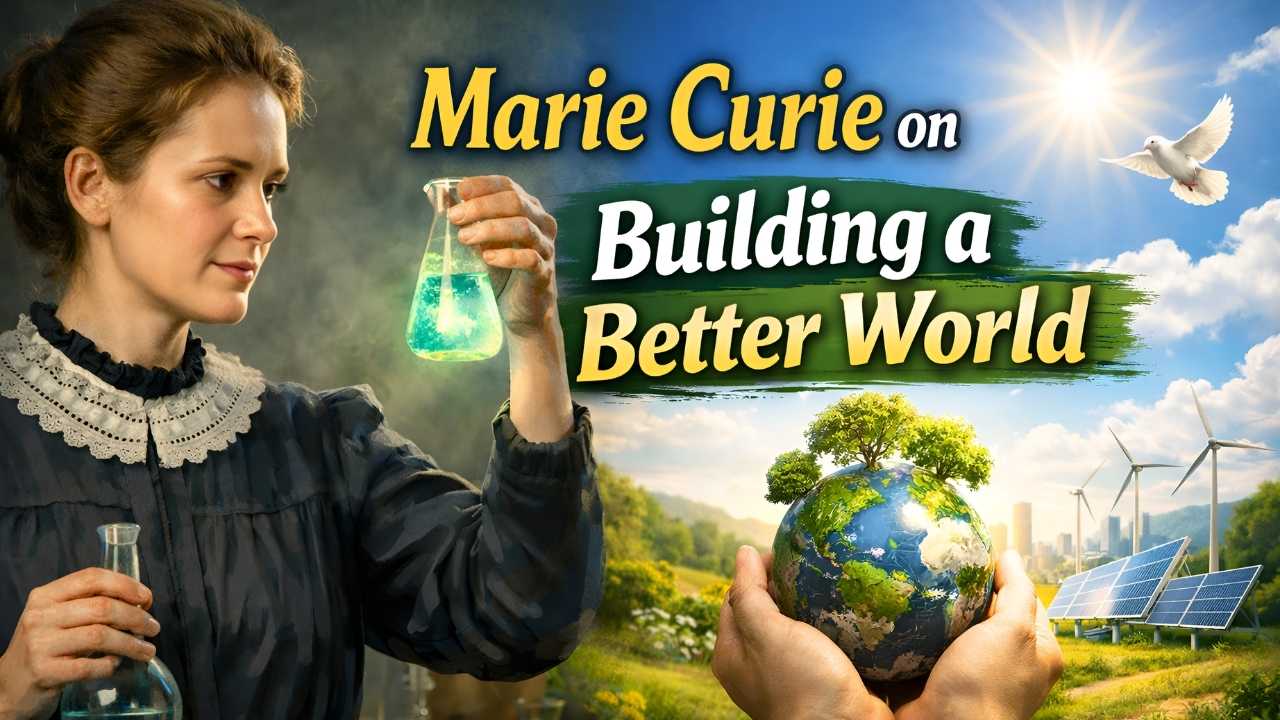
Marie Curie on Building a Better World: Marie Curie is remembered as one of the most brilliant scientists in history. She was the first woman to win a Nobel Prize and the only person to win Nobel Prizes in two different scientific fields, physics and chemistry. Her groundbreaking work on radioactivity changed the course of science and medicine. Yet beyond her discoveries, Curie believed in something even more powerful: the idea that building a better world begins with individuals.
The Human Side of Science
Curie’s life was not only about laboratories and experiments. She saw science as a way to serve humanity. Her research was driven by a desire to improve lives, not just to satisfy curiosity. This perspective highlights her belief that progress is not measured only in discoveries but in how those discoveries benefit people. For Curie, science was deeply connected to compassion and responsibility.

Starting with Individuals
Curie often emphasized that change begins with individuals. She believed that each person has the power to contribute to the betterment of society. Whether through scientific work, teaching, or simple acts of kindness, individuals shape the world around them. Her own life is proof of this principle. Despite facing poverty, gender bias, and personal loss, she pursued her passion and made contributions that transformed the world.
Overcoming Challenges
Marie Curie’s journey was filled with obstacles. As a woman in the late 19th century, she faced discrimination in academia. Resources were scarce, and her research often required immense sacrifice. Yet she persevered. Her determination shows that individuals can overcome barriers and still make lasting contributions. Her example inspires us to believe that personal effort, no matter how small, can ripple outward to create change.

The Role of Education
Curie valued education as a tool for empowerment. She believed that knowledge equips individuals to make meaningful contributions. After achieving success, she dedicated herself to teaching and mentoring. She wanted others to have the opportunity to learn and grow. This commitment reflects her belief that building a better world requires nurturing individuals through education and opportunity.
Science in Service of Humanity
Curie’s discoveries were not kept in isolation. She applied her knowledge to practical uses, such as developing mobile X-ray units during World War I. These units saved countless lives by helping doctors diagnose injuries on the battlefield. Her work shows that science, when guided by compassion, becomes a powerful force for good. It also demonstrates her belief that individuals can use their skills to serve humanity directly.

The Importance of Integrity
Curie lived with integrity and humility. Despite her fame, she remained dedicated to her work and avoided seeking personal glory. She believed that true success lies in contributing to the greater good. Her integrity reminds us that building a better world requires honesty, responsibility, and a focus on collective well-being rather than personal gain.
Inspiration for Modern Times
Curie’s philosophy is especially relevant today. In a world facing challenges such as inequality, climate change, and technological disruption, her reminder to start with individuals is powerful. Each person has the ability to make choices that contribute to progress. Whether through innovation, activism, or kindness, individuals shape the future. Curie’s life encourages us to believe in the impact of personal responsibility.

Building a Better World Together
While individuals are the starting point, Curie also recognized the importance of collaboration. Her work with her husband Pierre Curie and other scientists shows that collective effort amplifies individual contributions. Building a better world requires both personal responsibility and cooperation. When individuals come together with shared purpose, they create lasting change.
Conclusion
Marie Curie’s inspiring reminder that building a better world starts with individuals is timeless. Her life demonstrates that personal effort, integrity, and compassion can transform society. She overcame challenges, valued education, and used science to serve humanity. Her legacy teaches us that progress begins with each of us, and that even small acts of responsibility can ripple outward to create a better world. By following her example, we can embrace our role as individuals in shaping a brighter future.