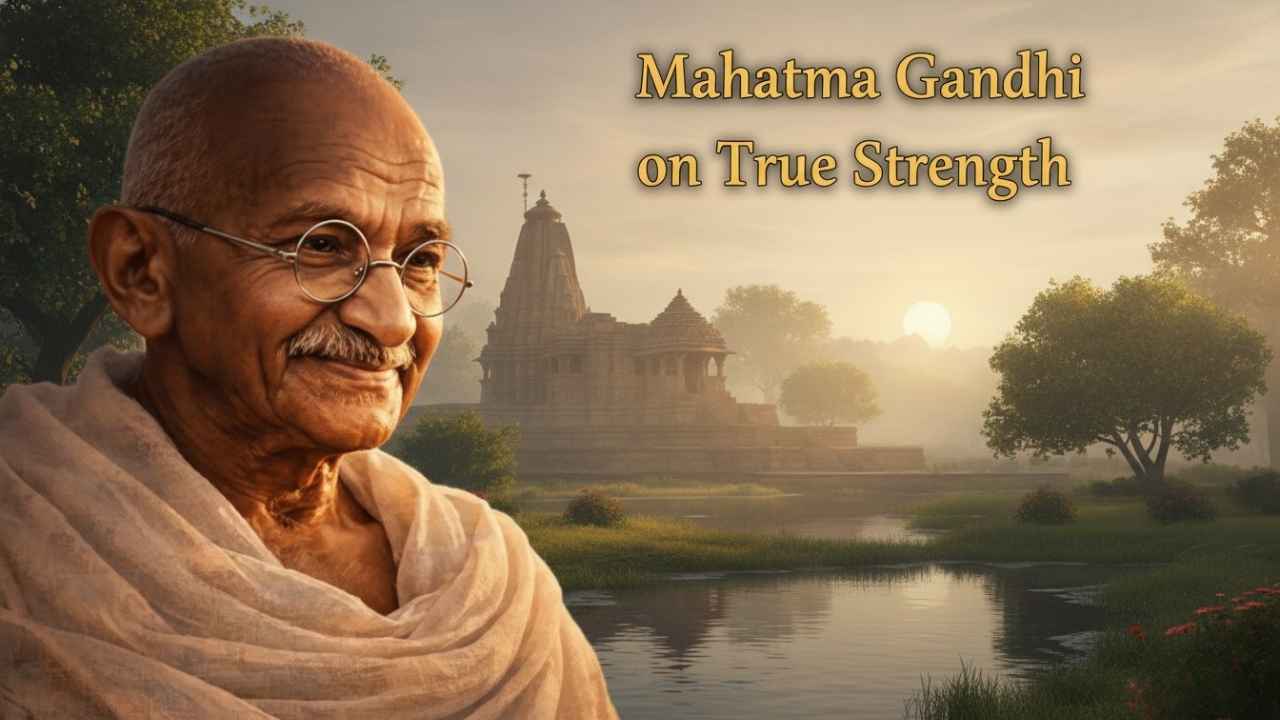
Mahatma Gandhi on True Strength: Mahatma Gandhi believed that strength is not measured by physical might but by the courage of the spirit. For him, true power came from the ability to remain steadfast in one’s principles, even in the face of adversity. Strength was not about domination but about resilience, patience, and moral conviction.
Courage Beyond Violence
Gandhi’s philosophy of nonviolence, or ahimsa, was rooted in the idea that inner courage surpasses physical force. He argued that anyone can strike a blow, but it takes far greater strength to resist anger and respond with compassion. Nonviolence was not weakness but the highest form of bravery, requiring discipline and self‑control.

The Power of Self‑Discipline
Inner courage is cultivated through self‑discipline. Gandhi practiced simplicity in his daily life, from his clothing to his diet, as a way of strengthening his spirit. By mastering his own desires and impulses, he demonstrated that true strength begins within. Physical power fades, but the strength of character endures.
Standing Firm Against Injustice
Gandhi’s life was a testament to the power of inner courage in confronting injustice. He faced imprisonment, ridicule, and opposition, yet he never abandoned his principles. His strength was not in weapons but in his unwavering commitment to truth and justice. This courage inspired millions to join him in the struggle for freedom.

Strength in Forgiveness
Forgiveness was central to Gandhi’s vision of strength. He believed that holding onto anger weakens the spirit, while forgiveness liberates it. To forgive those who wrong us requires immense inner courage. Gandhi showed that true strength is not about revenge but about rising above hatred to create peace.
The Role of Faith
Gandhi’s courage was deeply connected to faith. He trusted in the power of truth and the moral order of the universe. This faith gave him the strength to endure hardship and to continue his struggle without resorting to violence. Inner courage is sustained by belief in something greater than oneself.

Inspiring Collective Strength
Gandhi’s philosophy was not only personal but collective. He inspired entire communities to embrace nonviolence and courage. His leadership showed that when individuals cultivate inner strength, societies can resist oppression without physical force. Collective courage becomes a force more powerful than armies.
Strength in Simplicity
Gandhi’s simple lifestyle was itself an act of courage. In a world that valued wealth and power, he chose humility and restraint. This simplicity was not weakness but strength, a declaration that true power lies in living authentically and resisting material temptations. Inner courage is expressed in the ability to live with integrity.

The Enduring Legacy of Inner Courage
Gandhi’s legacy continues to inspire movements for justice and peace around the world. His belief that inner courage outweighs physical power remains relevant today. In workplaces, communities, and nations, true strength is found not in force but in integrity, compassion, and resilience.
Conclusion
Mahatma Gandhi redefined strength as inner courage rather than physical power. His life demonstrated that nonviolence, forgiveness, discipline, and faith are the true measures of bravery. Physical might may dominate for a moment, but inner courage shapes history. Gandhi’s philosophy challenges us to cultivate strength within, to stand firm in our values, and to live with compassion. True strength is not about conquering others but about conquering ourselves.